How to Measure Your Waist for the WHtR Test
The official Army WHtR measurement is taken at the level of the iliac crest — the top of your hip bone. That landmark carried over from the circumference-based tape test, but under Army Directive 2026-13 the measurement is the assessment itself, not a follow-on to weight screening.
Measuring yourself accurately is harder than it sounds. A one-inch error changes your WHtR by roughly 0.014–0.016 depending on your height — enough to move a borderline soldier across the threshold. Have a second person measure you when possible, and always measure honestly: a flattering number only moves the surprise to the official assessment.
What you need
- A flexible, non-stretch measuring tape (cloth or fiberglass — not metal)
- A mirror or a second person (a second person is better)
- A flat wall (for posture)
- Lightweight clothing or bare skin at the measurement level
Step-by-step protocol
- Stand with feet shoulder-width apart, weight evenly distributed.
- Locate the iliac crest — the top of your hip bone — on both sides. Place your hands on your hips and trace the bone upward and outward; the highest point on each side is the landmark.
- Wrap the tape around your torso at the level of the iliac crest, parallel to the floor all the way around.
- Adjust the tape so it is snug against the skin but not compressing it.
- Exhale normally — do not suck in or push out.
- Take the reading at the end of a normal exhale.
- Read the tape to the nearest ½ inch.
- Repeat twice more and use the average of the three readings.
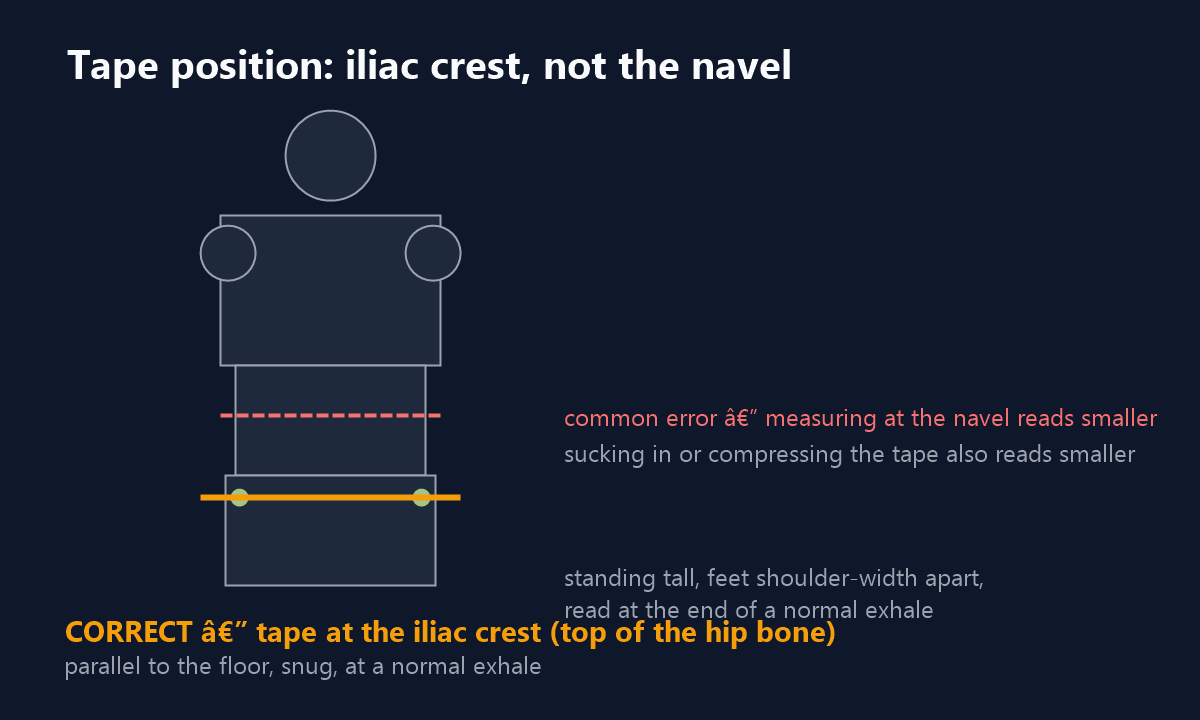
Original schematic diagram. The amber line marks the correct tape position at the iliac crest; the dashed red line shows the common navel error.
Common errors
- Measuring at the navel — reads smaller than the official landmark and is the most common home-measurement mistake.
- Inhaling or sucking in — reads smaller; the official protocol measures at a relaxed exhale.
- Compressing the tape — reads smaller; the tape should touch the skin without denting it.
- Measuring through thick clothing — reads larger; keep lightweight clothing or bare skin at the tape level.
- Measuring alone without a mirror — the tape may not stay level all the way around; a second person catches the tilt.
Self-measurement vs the official measurement
Self-measured waists typically run one to three inches smaller than official Army measurements, mostly because self-measurers align the tape at the navel rather than the iliac crest. Treat your home number as a planning tool, not a prediction of your official result — and if your honest measurement lands within about half an inch of your target, treat yourself as borderline and build margin.
Use the calculator
Once you have your measurement, run it through the WHtR calculator to see where you stand. To set a goal with margin instead of aiming at the line, use the waist target calculator. The arithmetic and rounding behind both tools are documented on the Methodology page.
Related
- WHtR calculator — the current standard
- Waist Target Calculator — your max waist with a comfort buffer
- Will I Pass the Army Height & Weight Test? — the complete guide
- How to Measure Your Height
Informational only — not an official ABCP determination. Official measurements are taken and recorded by Army personnel using the official protocol.